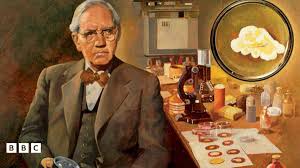
Penicillin is one of the greatest accidental discoveries in human history. Alexander Fleming found it not by planning, but by forgetting to clean a petri dish. That tiny moment of carelessness ended up saving over 200 million lives.
Penicillin and the Man Behind It: Who Was Alexander Fleming?
Alexander Fleming was a Scottish bacteriologist born on August 6, 1881. He grew up on a farm in Ayrshire, Scotland. Later, he moved to London to study medicine. He graduated from St. Mary’s Hospital Medical School in 1906 with top marks.
Fleming was curious by nature. He loved experimenting and observing tiny things others ignored. He worked at St. Mary’s Hospital for most of his career. His focus was on bacteria and how the body fights infections.
During World War I, Fleming served as a military doctor. He saw many soldiers die from infected wounds. That experience pushed him to search harder for ways to kill bacteria. It planted a seed that would eventually grow into one of medicine’s biggest breakthroughs.
He was also known for being a little messy in the lab. Funny enough, that messiness turned out to be a good thing.
Sources: Alexander Fleming Biography – Nobel Prize | St. Mary’s Hospital History
The Accidental Discovery of Penicillin
The year was 1928. Fleming had been working with Staphylococcus bacteria. Before going on holiday, he left some petri dishes on his lab bench. He did not clean them properly before leaving.
When he returned in September 1928, he noticed something odd. One of the dishes had mold growing on it. That was not unusual on its own. However, something else caught his eye.
Around the mold, the bacteria were dead. The mold had created a clear zone with no bacterial growth. Fleming looked closer and realized the mold was producing something that killed bacteria. That mold was Penicillium notatum.
He could have thrown the dish away. Instead, he stopped and asked questions. That moment of curiosity changed everything. He called the active substance “penicillin.” He published his findings in the British Journal of Experimental Pathology in 1929.
Interestingly, Fleming did not fully develop penicillin into a medicine at that point. He had trouble producing it in large amounts. Also, it broke down too quickly to be useful in that early form. So, the discovery sat quietly for about a decade.
Sources: Fleming’s Original 1929 Paper – PubMed | Science Museum – Discovery of Penicillin
How Penicillin Actually Works
Penicillin works by attacking the cell walls of bacteria. Bacteria need strong cell walls to survive. Without those walls, they fall apart and die.
Specifically, penicillin blocks an enzyme that bacteria use to build their walls. That enzyme is called transpeptidase. Once blocked, the bacteria cannot repair or build new walls. As a result, the bacteria burst and die.
This is why penicillin is so effective against many common infections. It targets bacteria without harming human cells. Human cells do not have the same type of cell walls. Therefore, the drug is relatively safe for people to use.
However, penicillin does not work on all bacteria. Some bacteria have outer membranes that block the drug. Others have developed resistance over time. This is a serious global health challenge today.
Sources: How Penicillin Works – Khan Academy | NIH – Beta-lactam Antibiotics
From Lab Discovery to Life-Saving Medicine
Fleming’s discovery was exciting, but it took more scientists to turn it into real medicine. In the late 1930s, a team at Oxford University picked up where Fleming left off. Howard Florey and Ernst Boris Chain led that effort.
By 1940, they had purified penicillin enough to test it on mice. The results were impressive. Mice infected with deadly bacteria survived when given penicillin. Those without it died. The proof was clear.
Then came the first human trial. In 1941, a police officer named Albert Alexander received penicillin. He had a life-threatening infection from a scratch. He began to improve after treatment. Sadly, the supply of penicillin ran out before he fully recovered. He passed away.
That failure pushed the team to produce more. By 1943, mass production had begun in the United States. Penicillin became widely available to Allied soldiers during World War II. It saved thousands of lives on the battlefield.
In 1945, Fleming, Florey, and Chain shared the Nobel Prize in Physiology or Medicine. They received it for the discovery and development of penicillin.
Sources: Nobel Prize 1945 – Fleming, Florey, and Chain | History of Penicillin Production – CDC
Penicillin in World War II: A Turning Point
Before penicillin, infected wounds were often deadlier than bullets. Soldiers died in large numbers from infections like gangrene and sepsis. Surgeons could do little to stop bacterial spread.
Penicillin changed the battlefield completely. By 1944, enough penicillin existed to treat all wounded Allied troops. Infection deaths dropped dramatically. Surgeons could now focus on trauma rather than infection.
Winston Churchill reportedly received penicillin during World War II. He developed pneumonia while traveling in 1943. Doctors used the new antibiotic to treat him successfully. Many believe penicillin saved his life.
The war also sped up the mass production of penicillin. Companies like Pfizer played a key role in scaling production. They developed a deep-tank fermentation method that increased output enormously. That method is still used today.
Sources: Penicillin in WWII – National WWII Museum | Pfizer and Penicillin History
Penicillin and Its Impact on Modern Medicine
The arrival of penicillin opened the door to a whole new era. Before antibiotics, simple infections could kill people. A scratch, a tooth infection, or pneumonia could be fatal. Penicillin changed all of that.
Diseases like scarlet fever, syphilis, and bacterial meningitis became treatable. Surgeries became safer because doctors could prevent post-operative infections. Even childbirth became much less deadly, as infections during delivery could now be treated.
Penicillin also inspired other antibiotics. Scientists began exploring different molds and bacteria. They found new substances that could fight infections in different ways. Today, there are dozens of antibiotic families, all tracing their roots back to Fleming’s discovery.
Life expectancy increased significantly after penicillin became widely available. The average life expectancy in the United States in 1940 was about 63 years. By 1960, it had risen to about 70 years. Antibiotics were a major reason for that jump.
Sources: Antibiotic Impact on Life Expectancy – JAMA | WHO – Antibiotics Overview
The Challenge of Antibiotic Resistance Today
Here is the part that is not so fun. Over time, bacteria have learned to fight back. Antibiotic resistance is now one of the biggest threats to global health.
When people use antibiotics too often or incorrectly, some bacteria survive. Those surviving bacteria pass their resistance on to future generations. Over time, entire strains of bacteria become untreatable.
Some bacteria today resist almost all known antibiotics. These are called superbugs. MRSA (methicillin-resistant Staphylococcus aureus) is one example. It causes infections that are very hard to treat.
Fleming himself warned about this. In his 1945 Nobel Prize speech, he said that misuse of penicillin could lead to resistant bacteria. He was absolutely right. His warning came decades before the problem became serious.
The World Health Organization lists antibiotic resistance as a global priority. Researchers are working hard to find new antibiotics and alternative treatments. Some are looking at bacteriophages, which are viruses that attack bacteria. Others are using AI to speed up drug discovery.
Sources: WHO – Antibiotic Resistance | CDC – Antibiotic Resistance Threats 2023 | Bacteriophage Therapy Research – Nature
Penicillin Allergy: What You Need to Know
Some people are allergic to penicillin. In fact, it is one of the most commonly reported drug allergies. About 10% of the population reports a penicillin allergy.
However, research shows that most of those people are not truly allergic. Studies suggest that up to 90% of people who think they are allergic can actually tolerate penicillin. Many “allergies” are side effects or reactions from years past that may not apply today.
If you think you are allergic to penicillin, talk to your doctor. An allergist can test you safely. Knowing whether you are truly allergic matters. It can open up better treatment options for you.
For those who are genuinely allergic, alternative antibiotics exist. Doctors can choose from several other families of drugs. However, some alternatives are less effective or have more side effects. That is why confirming true allergy status is important.
Sources: Penicillin Allergy – Mayo Clinic | Penicillin Allergy Delabeling – NEJM
Latest Research on Penicillin and Antibiotics
Science has not stopped with Fleming’s discovery. Researchers today are building on his work in exciting ways. New forms of penicillin are being developed to fight resistant bacteria.
One recent area of focus is combining penicillin with other compounds. These combinations can overcome bacterial defenses. For example, clavulanic acid is added to amoxicillin to create Augmentin. This combination works against bacteria that would otherwise resist the drug.
Scientists are also using artificial intelligence to discover new antibiotics faster. In 2023, a team at MIT used AI to find a new antibiotic called Abaucin. It targets a dangerous drug-resistant bacterium called Acinetobacter baumannii. This is a major step forward.
Another growing field is phage therapy. Researchers are testing bacteriophages as an alternative or supplement to antibiotics. Early results are promising, especially for patients with infections that do not respond to drugs.
Sources: AI-Discovered Antibiotic Abaucin – Nature Chemical Biology | Phage Therapy Clinical Trials – ClinicalTrials.gov | New Penicillin Combinations – Lancet
Fun Facts About Penicillin You Probably Did Not Know
Let’s take a quick detour into some surprising territory. Fleming was reportedly a fan of creating art with bacteria. He would grow colorful bacteria in patterns to create pictures. That shows how much he loved the tiny world of microbes.
Penicillin was also used to treat Winston Churchill, Joseph Stalin, and Franklin D. Roosevelt at different times. World leaders during World War II benefited from Fleming’s discovery. That is quite a VIP list.
The first commercial penicillin was sold in 1943. By 1944, American pharmaceutical companies were producing 650 billion units of it per month. That number sounds almost impossible, but it is true.
Penicillin mold is blue-green in color. You may have seen it on old bread or fruit. Not all mold is penicillin-producing, but Penicillium notatum is the famous one.
Penicillin’s Global Reach: Medicine for Everyone
In the early days, penicillin was rare and expensive. It was given mainly to soldiers and wealthy patients. Over time, production costs dropped. The drug became available to people around the world.
Today, penicillin and its relatives are among the most widely used drugs globally. They treat infections in rich and poor countries alike. In many low-income nations, basic penicillin is still a frontline drug against common infections.
Organizations like the World Health Organization include penicillin on their list of essential medicines. That list covers drugs considered most important for public health worldwide. Penicillin has been on that list since it was first published in 1977.
Access to penicillin has also helped reduce child mortality. Bacterial infections are a leading cause of death in children under five in developing countries. Affordable antibiotics have saved countless young lives.
Sources: WHO Essential Medicines List | UNICEF – Child Mortality and Infections
Alexander Fleming’s Legacy
Fleming received many honors during his lifetime. Besides the Nobel Prize, he was knighted in 1944 and became Sir Alexander Fleming. He received honorary degrees from universities around the world.
He remained humble about his discovery. He often said that the real credit belonged to the mold. He believed he just had the luck to notice something important. That humility is one reason people remember him so fondly.
Fleming died on March 11, 1955. He was 73 years old. He is buried in St. Paul’s Cathedral in London. His grave sits near those of other great British figures.
His legacy lives on in every dose of penicillin given today. It lives on in every life saved from bacterial infection. It lives on in the countless antibiotics developed since his time. His messy lab bench may have been his greatest asset.
Sources: Fleming’s Life – British Library | Fleming Archive – St. Mary’s Hospital
Conclusion: A Small Mold With a Giant Story
Penicillin started as a moldy petri dish that Fleming almost threw away. Today, it is one of the most important medicines ever made. The story of penicillin is also the story of curiosity, patience, and teamwork.
Fleming noticed something others would have ignored. Florey and Chain turned that observation into a drug. Thousands of scientists since have built on that foundation. Together, they changed the course of human history.
Penicillin did not just treat infections. It transformed how doctors think about disease and treatment. It showed the world that nature holds powerful cures. It also taught us that science sometimes needs a messy lab and a long holiday.
So, the next time you take an antibiotic, take a second to think about a Scottish scientist and a forgotten petri dish. That small moment of forgetfulness helped build modern medicine.
Sources and Further Reading
- Alexander Fleming – Nobel Prize Biography
- Fleming’s 1929 Original Paper – PubMed Central
- Penicillin Discovery – Science Museum UK
- Penicillin in World War II – National WWII Museum