
Introduction
Space rocks have been hiding a big secret for billions of years. Scientists now confirm that all five building blocks of life exist inside meteorites and asteroids. These findings are reshaping everything we thought we knew about how life began on Earth.
Space Rocks and the Origin of Life
For a long time, researchers asked one bold question. Could life on Earth have started in outer space? Today, the answer looks closer than ever.
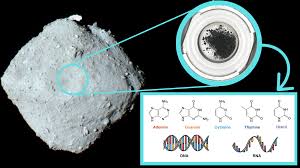
Scientists have now found all five nucleobases inside space rocks. Nucleobases are the chemical letters that make up DNA and RNA. Without them, life as we know it simply could not exist.
These five compounds are adenine, guanine, cytosine, thymine, and uracil. Together, they form the entire genetic alphabet. They were all found in meteorites and asteroid samples returned from space.
This discovery did not happen overnight. Researchers detected adenine and guanine in meteorites back in the 1960s. However, cytosine, thymine, and uracil proved much harder to find. New techniques finally solved that problem in 2022. Source: Science News
Why Scientists Study Space Rocks So Carefully
Space rocks preserve ancient chemistry. Some of these rocks formed over 4.5 billion years ago, right at the birth of our solar system.
Unlike Earth, which constantly changes, asteroids stay mostly frozen in time. As a result, they hold a kind of chemical time capsule. Scientists can study this material to understand what the early Earth looked like.
Importantly, rocks that fall to Earth as meteorites can get contaminated. They interact with soil, water, and air. Pristine asteroid samples avoid that problem entirely. That is why missions to asteroids like Ryugu and Bennu are so valuable.
The 5 Building Blocks Found in Space Rocks
1. Adenine: The First Letter of Life
Adenine is one of the two purines found in both DNA and RNA. It pairs with thymine in DNA and with uracil in RNA. Scientists first detected adenine in meteorites decades ago.
Adenine bonds with sugars and phosphates to create the larger structures of DNA. Without adenine, genetic information cannot pass from one generation to the next. Its presence in space rocks strongly suggests that life’s ingredients are widespread in the cosmos.
Researchers found adenine in the Murchison meteorite, which landed in Australia in 1969. That meteorite has since become one of the most studied space rocks in history. Scientists have extracted over 90 different organic molecules from it. Source: IFLScience
2. Guanine: The Stable Partner
Guanine is adenine’s companion in the purine family. It appears in both DNA and RNA. Guanine was also detected in meteorites in the early days of astrobiology research.
In DNA, guanine pairs with cytosine. This pairing forms a strong and stable bond. That stability is one reason DNA is such a reliable carrier of genetic information.
The Murchison, Murray, and Tagish Lake meteorites all showed high concentrations of guanine. Notably, the Murchison meteorite contained more purines, including guanine, than any other meteorite studied. This shows that some space rocks are richer in certain nucleobases than others. Source: The Conversation
3. Cytosine: The Missing Piece That Was Finally Found
For years, cytosine was the hardest nucleobase to find in space rocks. Earlier extraction methods were too harsh. They destroyed fragile molecules like cytosine before scientists could even detect them.
A team from Hokkaido University in Japan changed everything. They developed a gentler extraction technique, described as working like a cold brew rather than hot tea. This method preserved delicate compounds that had been missed before.
Using this approach, the team successfully found cytosine in three meteorites. The discovery filled a major gap in the scientific record. Now, researchers could confirm that all five nucleobases existed in ancient space rocks. Source: Space.com
4. Thymine: The DNA-Exclusive Base
Thymine is unique because it only appears in DNA, not RNA. In RNA, uracil takes its place. Thymine had long been considered the hardest nucleobase to detect in meteorites.
Like cytosine, thymine belongs to the pyrimidine group. Pyrimidines have a simpler structure than purines. They consist of just one six-membered nitrogen ring. That simpler structure made scientists think pyrimidines would form easily in space.
However, finding them proved difficult for a long time. The same Hokkaido University research team found thymine alongside cytosine and uracil. They detected it in all three meteorites they studied. The concentrations were small but clearly measurable. Source: The Scientist
5. Uracil: The RNA Specialist
Uracil does a job that thymine handles in DNA. It pairs with adenine in RNA strands. Uracil was actually one of the first pyrimidines suspected to exist in meteorites.
Before 2022, hints of uracil had appeared in space rocks. Still, earlier methods could not confirm its presence with confidence. The new extraction techniques resolved all remaining doubt.
Furthermore, uracil was one of the first nucleobases confirmed in pristine asteroid samples. Researchers studying material from asteroid Ryugu detected uracil as early as 2023. This finding, from an uncontaminated source, made the result far more convincing. Source: Astrobiology.com
Asteroid Ryugu Changes Everything
Japan’s Hayabusa2 spacecraft launched in December 2014. Its target was the asteroid Ryugu, a spinning-top-shaped rock near Earth. The mission made two landings on Ryugu’s surface in 2019.
The spacecraft returned to Earth in December 2020, carrying precious asteroid samples. Initial analysis found uracil and vitamin B3 in the samples. Scientists then analyzed two additional Ryugu samples more recently.
Both samples contained all five nucleobases. Additionally, the researchers found that Ryugu contained nearly equal amounts of purines and pyrimidines. That balance was different from what other meteorites had shown. Source: Chemistry World
Consequently, Ryugu offered the most complete picture yet. Space rocks like Ryugu carry a diverse mix of prebiotic chemistry. Therefore, these rocks could have seeded Earth with many key ingredients at once.
Asteroid Bennu Adds More Proof
NASA’s OSIRIS-REx mission traveled to asteroid Bennu. The spacecraft collected 121.6 grams of material, the largest asteroid sample ever returned to Earth. Those samples arrived in September 2023.
Japanese collaborators analyzed the Bennu samples for nucleobases. They found all five present in the material. Additionally, the Bennu samples contained 14 of the 20 amino acids that life uses to build proteins.
Amino acids and nucleobases together represent two major categories of life’s building blocks. Finding both in the same asteroid sample is remarkable. It supports the idea that space rocks carried a rich chemistry toolkit to the early Earth. Source: Astrobiology.com
How These Molecules Formed in Space Rocks
Scientists now have a clearer picture of how nucleobases formed inside space rocks. High-energy radiation in space likely played a big role. This radiation can convert simple molecules like hydrogen cyanide into complex nucleobases.
Once formed, these molecules became trapped inside growing asteroids. Asteroids collected dust and ice as the solar system formed around the young Sun. The nucleobases mixed into this material and stayed preserved for billions of years.
Interestingly, ammonia also influenced which nucleobases formed in larger quantities. Asteroids with more ammonia tended to produce more pyrimidines. Asteroids with less ammonia were richer in purines. Source: Nature Astronomy
This explains why different space rocks show slightly different chemical mixes. Each asteroid tells a slightly different story about its formation environment.
What Separates Contaminated Meteorites from Pristine Samples
When meteorites land on Earth, they face immediate contamination risks. Soil, water, and biological material all seep into the rocks. Scientists must work hard to separate what came from space and what came from Earth.
One key strategy involves looking for isomers. Isomers are molecules with the same chemical formula but different arrangements. Space-formed nucleobases tend to come alongside specific isomers that do not appear in soil. If contamination had occurred, those isomers would show up in nearby soil samples too.
Researchers tested this idea with the Australian Murchison meteorite site. They found the special isomers inside the meteorite but not in the surrounding soil. That result strongly supports the extraterrestrial origin of the nucleobases. Source: Science News
Space Rocks and the Prebiotic Soup Theory
One widely accepted idea about the origin of life involves a prebiotic soup. Early Earth had oceans rich in organic chemicals. These chemicals reacted over millions of years to eventually produce living cells.
Space rocks may have helped fill that soup with key ingredients. When asteroids and comets struck the young Earth, they delivered nucleobases and other organic compounds directly into the oceans. These molecules then had time to react and combine.
NASA astrobiologist Daniel Glavin put it simply. He said the research shows these compounds were available on early Earth before life even began. So in a sense, space rocks may have written the first chapters of the story of life. Source: European Commission CORDIS
Space Rocks Throughout the Solar System
The discovery of nucleobases in multiple space rocks is especially exciting. Ryugu, Bennu, Murchison, Murray, Orgueil, and Tagish Lake all show similar results. This spread of findings suggests that prebiotic chemistry is not rare or unusual.
Instead, the building blocks of life appear to be a standard part of how carbon-rich asteroids form. These rocks make up a large portion of the asteroid belt. Therefore, life’s ingredients may have been plentiful in the early solar system.
Furthermore, similar chemistry could exist on asteroids and comets throughout the galaxy. That opens up the possibility that life’s ingredients exist elsewhere beyond our solar system too. The story of life may be a cosmic story, not just an Earth story.
Future Missions Will Keep Exploring Space Rocks
Scientists are far from done exploring space rocks. Japan’s Hayabusa2 extended mission is now targeting new asteroids. NASA is planning future sample-return missions as well. Each new sample adds to the growing library of extraterrestrial chemistry.
Advances in analytical techniques also continue to improve. Researchers can now detect nucleobases at concentrations of just a few parts per trillion. That sensitivity is 10 to 100 times better than older methods. So even tiny samples can reveal rich chemical details.
As a result, the field of astrobiology is moving fast. Each new space rock studied adds another clue to the puzzle of how life began. The answers, when they finally come, may surprise even the most seasoned scientists.
Key Takeaways About Space Rocks and Life’s Building Blocks
Space rocks have given science some of its most exciting discoveries in recent years. All five nucleobases of DNA and RNA now have confirmed presences in meteorites and asteroid samples. These findings come from multiple independent research teams and multiple different space rocks.
Together, the five nucleobases form the complete genetic alphabet of life. Finding them in space strongly suggests that life’s chemistry did not start from scratch on Earth. Some, or even all, of the key ingredients may have arrived from the cosmos.
The story of life on Earth, therefore, is also the story of space rocks. Ancient asteroids may have carried the seeds of life across the void of space. Then they delivered those seeds to a young and waiting planet.
External Sources and References
- Science News: All DNA and RNA Bases Found in Meteorites
- Space.com: Meteorites Brought DNA Blocks to Early Earth
- Astrobiology.com: Life’s Building Blocks in Asteroid Bennu
- The Conversation: All 5 Nucleobases in Asteroid Ryugu