
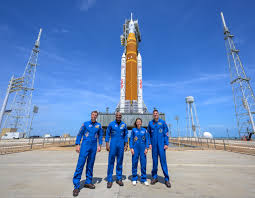
Artemis II launched on April 1, 2026, making history once again. Four astronauts are now flying around the moon for the first time in over 50 years. This mission is a bold new chapter in space exploration.
Artemis II: The Mission That Brought Humans Back to Deep Space
The world watched closely on April 1, 2026. NASA’s Artemis II mission lifted off from Kennedy Space Center in Florida at 6:35 p.m. EDT. Furthermore, it marked the first crewed flight beyond low Earth orbit since Apollo 17 in December 1972. Additionally, it was the beginning of a new era for human spaceflight.
The Space Launch System (SLS) rocket carried the Orion spacecraft into the sky. On top of the rocket, four astronauts were ready to make history. Together, they set off on a journey of approximately 695,081 miles in total. Source: NASA Artemis II Mission Page
Meet the Artemis II Crew
The Artemis II crew is made up of four remarkable individuals. NASA astronaut Reid Wiseman serves as the mission commander. Moreover, NASA astronaut Victor Glover and mission specialist Christina Koch are also on board. In addition, Canadian Space Agency astronaut Jeremy Hansen rounds out the crew.
These four people are now the farthest humans from Earth since 1970. Notably, Artemis II will surpass the Apollo 13 record by about 4,102 miles. Therefore, the crew will reach a maximum distance of 252,757 miles from Earth.
Breaking Records in Space
One of the most exciting parts of Artemis II is the record it will break. The Apollo 13 crew set the farthest human distance record in 1970. Specifically, they traveled 248,655 miles from Earth. However, Artemis II will beat that record on Day 6 of the mission.
At around 1:56 p.m. on April 6, the crew is expected to surpass that milestone. Consequently, this moment will make headlines all over the world. As a result, Artemis II will cement its place in the history books. Source: NASA Q&A on Artemis II
The Orion Spacecraft: Built for Deep Space
The Orion spacecraft is at the heart of the Artemis II mission. It was built to carry astronauts safely through deep space. Also, it is designed to survive the harsh conditions far beyond Earth’s orbit.
Inside the 16.5-foot-wide capsule, the crew lives, works, and rests. Furthermore, Orion’s systems are being tested throughout the journey. Specifically, the crew is evaluating life-support, propulsion, power, thermal, and navigation systems. Source: NASA SLS and Orion Overview
The spacecraft also features cameras on its solar array wings. Therefore, the crew can capture stunning images of the moon and Earth. Indeed, some of those photos have already been shared publicly.
Artemis II and the Free Return Trajectory
A key part of the Artemis II flight plan is something called a “free return trajectory.” Simply put, this means the spacecraft can return to Earth even without firing its engine. Because of orbital physics and the moon’s gravity, Orion will loop around the moon and head back automatically.
This approach makes the mission safer for the crew. Additionally, it gives mission controllers more confidence in the plan. Therefore, the free return trajectory is a smart and well-tested strategy. Source: CNN Artemis II Coverage
The Lunar Flyby: A View Like No Other
The most anticipated moment of the Artemis II mission is the lunar flyby. On April 6, 2026, the crew will swing around the far side of the moon. Moreover, this is a view that no human has had up close in more than five decades.
During the flyby, the spacecraft will pass within 4,066 miles of the lunar surface. Furthermore, the crew will spend about seven hours observing the moon during this period. Importantly, they will divide into pairs to take turns looking out the windows.
The images and observations from this flyby will be very valuable. In fact, they could help inform future Artemis landing site decisions. Also, the crew’s descriptions will give scientists new data about the moon’s surface. Source: NASA Journey to the Moon Gallery
Science Goals of Artemis II
Beyond the flyby, Artemis II has several science goals. One of them involves a study called AVATAR, which stands for A Virtual Astronaut Tissue Analog Response. Essentially, this study uses organ-on-a-chip devices to measure how radiation and microgravity affect the human body.
Furthermore, the crew is testing key spacecraft systems in a real deep space environment. This kind of data cannot be gathered any other way. Therefore, the science done on Artemis II will directly support future moon missions.
The crew is also practicing important mission procedures. For example, they are testing trajectory adjustments and communications at lunar distances. Additionally, they are practicing piloting Orion during key flight phases.
Connecting With the International Space Station
One touching moment planned for the Artemis II mission is a special call. On the seventh day of the mission, the crew will contact astronauts aboard the International Space Station. Moreover, this ship-to-ship call will be a first of its kind.
NASA astronaut Jessica Meir, currently on the ISS, expressed excitement about connecting with the Artemis II crew. Also, she noted that she and Christina Koch performed the first all-female spacewalk together in 2019. Indeed, this call will bring together the past and the future of human spaceflight. Source: Wikipedia Artemis II
The Road to Artemis II Was Not Easy
Getting Artemis II off the ground took years of hard work. After the uncrewed Artemis I mission in November 2022, engineers found unexpected heat shield erosion. Consequently, NASA spent considerable time studying and addressing the issue.
In addition, the life-support system required months of investigation. As a result, the launch was delayed multiple times. Nevertheless, NASA pushed forward and targeted an April 2026 launch. Finally, on April 1, 2026, Artemis II became a reality.
Rocket stacking began in November 2024 and was completed by October 2025. Then, on January 18, 2026, the fully integrated rocket rolled out to Launch Complex 39B. Clearly, the effort that went into Artemis II was enormous.
Artemis II and the Bigger Picture
Artemis II is not just about this one mission. Rather, it is a stepping stone toward something much larger. NASA plans to use lessons learned from this mission to guide future Artemis flights.
Artemis III is planned for mid-2027 and will test a lunar lander in Earth orbit. After that, Artemis IV, scheduled for early 2028, aims to land humans on the moon. Furthermore, NASA hopes to establish a permanent lunar base over time.
Therefore, Artemis II plays a critical role in making all of that possible. Without it, NASA could not move forward with confidence. Moreover, the data gathered on this mission will shape the design of future lunar landers and suits. Source: Wikipedia Artemis Program
A Moment the World Is Watching
People all around the world have been following Artemis II closely. NASA has been broadcasting activities from inside the Orion capsule nearly every day. Also, public affairs events have given journalists the chance to speak directly with the crew.
During one such event, Commander Wiseman shared a moving moment. Mission control reoriented the spacecraft as the sun set behind Earth. As a result, the crew saw something so stunning it left them speechless.
Indeed, moments like these remind us all of the power of human exploration. The Artemis II mission is doing more than testing hardware. Rather, it is inspiring millions of people to look up at the sky and dream. Source: CNN Artemis II Images
Looking Ahead After Artemis II
Artemis II is changing what humans believe is possible. After this mission, NASA will be better equipped to plan moon landings. Furthermore, the Orion spacecraft will have proven itself in deep space.
The lessons from Artemis II will be applied to every mission that follows. In particular, the heat shield design will be improved for Artemis III based on new data. Also, crew habitability insights will lead to a more comfortable spacecraft for longer missions.
Most importantly, Artemis II is showing the world that humanity is ready to go back to the moon. Clearly, space exploration has entered an exciting new era. As a result, the coming years promise to bring even more historic milestones.
External Sources and References
- NASA Official Artemis II Mission Page
- NASA Q&A: Artemis II Most Pressing Questions
- NASA Artemis Blog
- NASA Journey to the Moon Gallery