
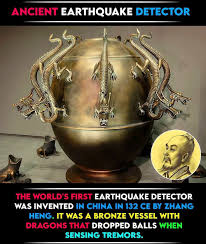
Earthquakes have shaken China for thousands of years, and the Chinese were among the first to fight back. One brilliant inventor changed everything with a bronze jar, eight dragons, and some very patient toads. This is the story of how China built the world’s first earthquake detector.
Earthquake Country: Why China Needed a Detector So Badly
China sits on some of the most active seismic ground on Earth. The country has experienced devastating tremors throughout its long history. So, it is no surprise that the Chinese were the first civilization to seriously tackle earthquake detection.
During the Eastern Han Dynasty (25 to 220 AD), seismic events were not just natural disasters. They were seen as messages from heaven. Rulers believed that a major tremor meant the heavens were unhappy with the emperor’s leadership. Therefore, knowing when and where one struck was both a political and spiritual matter.
Remote provinces would shake violently, and the imperial court in Luoyang would have no idea. Help could not arrive if no one knew a disaster had happened. Clearly, China needed a solution, and one remarkable man stepped up to provide it.
Zhang Heng: The Genius Behind the World’s First Earthquake Detector
<cite index=”16-1″>Zhang Heng (AD 78 to 139) was a Chinese polymath and statesman who lived during the Eastern Han Dynasty.</cite> He was not just an inventor. He was also a royal astronomer, distinguished cartographer, mathematician, poet, painter, and one of the most creative minds of the ancient world. Basically, he was the Leonardo da Vinci of ancient China, but about 1,300 years earlier.
<cite index=”2-1″>Zhang was also a mathematician and mechanical engineer who constructed many practical devices, including a cart for measuring the Chinese mile, and an early armillary sphere.</cite> Still, none of those inventions matched what he created in 132 AD.
<cite index=”8-1″>In 132, Zhang Heng presented to the Han court what many historians consider to be his most impressive invention, the first seismoscope. It was named “earthquake weathervane” and it was able to roughly determine the direction, out of eight directions, where the earthquake came from.</cite>
Think about that for a moment. Nearly 1,900 years ago, a man built a machine that could tell you which direction an earthquake came from, even if the quake happened hundreds of miles away. That is genuinely mind-blowing.
Further reading: Zhang Heng on Wikipedia
The Houfeng Didong Yi: What Did the Machine Look Like?
The device had a proper name: the Houfeng Didong Yi, which roughly means “instrument for measuring the seasonal winds and the movements of the earth.” Quite the title for what looked like a very fancy bronze jar.
<cite index=”3-1″>While there are no surviving physical remnants or illustrations of his seismoscope, historical descriptions depict it as being a large bronze instrument, similar in shape to an urn or a vase. Mounted on the outside were eight dragons, each with a bronze ball clasped within its jaw. Directly underneath these mythical protrusions were eight bronze toads, mouths agape to receive the balls if they fell.</cite>
<cite index=”4-1″>Zhang’s seismoscope was a giant bronze vessel, resembling a samovar almost 6 feet in diameter. Eight dragons snaked face-down along the outside of the barrel, marking the primary compass directions.</cite> Each dragon pointed in one of eight directions: north, south, east, west, and the four diagonal points in between.
So you had eight dragons sitting on a bronze pot, each one holding a ball in its mouth, with a toad sitting underneath each dragon waiting to catch the ball. Medieval observers probably found it equal parts impressive and bizarre.
Learn more about the physical design: Ancient Origins
How Did the Earthquake Detector Actually Work?
This is where things get really interesting. The outer design looked dramatic, but the inner mechanism was pure engineering genius.
<cite index=”11-1″>Inside the hollow body of the seismoscope hung a pendulum, while lever mechanisms connected to each of the dragons flanked this pendulum on all sides. The shockwaves of an earthquake would cause the pendulum to swing, activating one of the mechanisms inside. The corresponding dragon would gift its ball to the toad, informing the court that not only had an earthquake occurred, but from which general direction the tremors came.</cite>
<cite index=”5-1″>Most experts agree that it worked on the principle of inertia. A mass is suspended. An earthquake shakes the vessel, causing a slight displacement between the unmovable mass and the vessel.</cite>
In simple terms: everything inside the pot stays still during a quake, while the pot itself shakes. That difference in movement triggers the mechanism. The right dragon drops its ball into the toad’s mouth below. The direction of the ball drop tells you the direction of the earthquake.
<cite index=”6-1″>This is distinct from a seismograph, which not only detects but also records seismic waves caused by earthquakes. Early seismoscopes, like the one invented by Zhang Heng, used a pendulum to trigger a mechanism that indicated the direction of shaking.</cite>
It was a seismoscope, not a full seismograph. It could tell you an earthquake happened and where it came from. However, it could not record the exact time, size, or duration of the shaking.
Read the science behind inertia and pendulums: Britannica on Seismoscopes
The Day the Dragon Dropped: Proof That It Worked
For a while, the court was not convinced. <cite index=”3-1″>Zhang Heng’s invention was initially met with skepticism. His views on certain topics made him unpopular with some of his peers, and worse yet, his seismoscope was unproven.</cite>
Then came the moment that changed everything.
<cite index=”5-1″>On one occasion one of the dragons let fall a ball from its mouth though no perceptible shock could be felt. All the scholars at the capital were astonished at this strange effect occurring without any evidence of an earthquake. But several days later a messenger arrived bringing news of an earthquake in Lung-Hsi, 400 miles away. Upon this everyone admitted the mysterious power of the instrument.</cite>
The earthquake detector had detected a magnitude 7 quake from 400 miles away. The court was speechless. The skeptics went quiet. And Zhang Heng went down in history.
<cite index=”2-1″>In 2006, Chinese scientists studying historical records figured out that this quake was magnitude 7 on the Richter scale, a pretty big shaker.</cite>
Who Else Was Zhang Heng? A Life Beyond the Earthquake Detector
It would be unfair to reduce Zhang Heng to just one invention. His life was packed with achievements that would impress any era.
He calculated the value of pi more accurately than most of his contemporaries. He made one of the earliest known water-powered armillary spheres, which modeled the movements of the stars. His poems were celebrated by scholars. His maps of the stars catalogued more than 2,500 stars.
<cite index=”7-1″>Heng believed tremors were actually caused by wind and air.</cite> That belief was wrong by modern standards, but it was a rational scientific attempt to explain a natural phenomenon. He was trying to find causes rather than simply accepting supernatural explanations.
<cite index=”4-1″>The ancient Chinese did not understand that seismic activity was caused by the shifting of tectonic plates in the Earth’s crust. Instead, the people explained them as disturbances with cosmic yin and yang, along with the heavens’ displeasure.</cite> Zhang Heng tried to go beyond myth. That alone made him extraordinary.
What Happened to the Original Earthquake Detector?
Here is the sad part of the story. The original Houfeng Didong Yi is gone. No one knows exactly when or how it disappeared.
<cite index=”13-1″>The physical device and its plans have since been lost to time. “The loss of the seismoscope was likely caused directly by war and chaos.”</cite>
China went through centuries of upheaval after the Han Dynasty fell. Wars, invasions, and political chaos destroyed much of the historical record. The original machine vanished along with its precise blueprints.
What remained were written descriptions. The most important source is the Book of Later Han, compiled by the historian Fan Ye in the 5th century. Those descriptions gave later researchers just enough to work with, but not quite enough to be certain of the exact inner design.
Source on historical records: Chinese Historical and Cultural Project
The Long Puzzle: Trying to Rebuild the Earthquake Detector
For centuries, scholars debated how the machine actually worked on the inside. Nobody really knew. The outer shape was described clearly. The inner mechanism remained a mystery.
<cite index=”10-1″>While it was John Milne and Wang Zhenduo who argued early on that Zhang’s “central pillar” was a suspended pendulum, Imamura was the first to propose an inverted model. He argued that transverse shock would have rendered an immobilization mechanism ineffective, as it would not have prevented further motion that could knock other balls out of their position.</cite>
<cite index=”10-1″>Wang Zhenduo presented two different models of the seismoscope based on the ancient descriptions. In his 1936 reconstruction, the central pillar of the device was a suspended pendulum acting as a movement sensor, while the central pillar of his second model in 1963 was an inverted pendulum.</cite>
Researchers across Japan, China, and the West spent decades trying to crack the puzzle. <cite index=”10-1″>According to Needham, while working in the Seismological Observatory of Tokyo University in 1939, Akitsune Imamura and Hagiwara made a reconstruction of Zhang’s device.</cite>
Still, the debate continued. Some replicas worked reasonably well. Others failed to match the precision described in ancient texts.
Read the academic reconstruction research: ScienceDirect Reconstruction Paper
The 2005 Breakthrough: Modern Chinese Scientists Rebuild the Detector
More than 1,800 years after Zhang Heng first presented his invention, modern scientists finally cracked the code.
<cite index=”10-1″>On June 13, 2005, modern Chinese seismologists announced that they had successfully created a replica of the instrument.</cite> The replica was reported to detect earthquakes with accuracy comparable to modern instruments. It was a proud moment for Chinese science and history.
<cite index=”15-1″>A 2005 replica was even said to detect earthquakes with the same precision as modern instruments.</cite>
The reconstruction confirmed the basic theory. A pendulum inside the bronze vessel swings when an earthquake occurs. The swing triggers levers connected to the dragons. One dragon releases its ball. The direction of the ball drop points toward the earthquake’s origin.
<cite index=”12-1″>The Zhang Heng device featured in studies leading to the development of modern seismographs. Dr John Milne described it in the nineteenth century, appreciating the principle of inertia used in the set-up of the pendulum. His own seismograph and subsequent seismographs were based on refinements of this same principle.</cite>
Replicas Around the World: Where You Can See the Earthquake Detector Today
You do not have to travel to ancient China to see the Houfeng Didong Yi. Several replicas exist in museums around the world.
<cite index=”2-1″>Replicas exist, including one in the Museum of Chinese History in Beijing and another in an exhibit at the Chabot Space and Science Center in Oakland, California.</cite>
<cite index=”12-1″>The Zhang Heng device at Te Papa museum in New Zealand is a half-size bronze replica of the original instrument. It was given to Te Papa and the people of Wellington by the people of the city of Beijing. It is the first of this type to leave China.</cite>
Each replica is a tribute to one of the most creative minds in the ancient world. Standing next to one of them, you can almost feel what it must have been like to watch a bronze ball fall into a toad’s mouth and know that an earthquake had just struck somewhere far away.
From Han Dynasty to the Han Seismograph Network
After the Han Dynasty, earthquake recording in China did not stop. Scholars and officials continued to log earthquake events across the centuries. These written records became valuable data for modern seismologists studying historical seismic patterns.
During the Qing Dynasty (1644 to 1912), detailed seismic catalogs were kept. Officials recorded dates, locations, and descriptions of shaking across the empire. These records remain useful for researchers today.
Then came the 20th century. China began building modern seismological institutions. After the catastrophic 1976 Tangshan earthquake, which killed over 240,000 people, the government invested heavily in earthquake science. The urgency was clear. The country needed better tools.
Research on the Tangshan earthquake and its legacy: USGS Earthquake History
The 2008 Sichuan Earthquake and the Push for Better Detection
On May 12, 2008, a magnitude 7.9 earthquake struck Sichuan Province. Nearly 87,000 people died. Thousands of schools collapsed. The disaster shocked the world and exposed serious weaknesses in China’s earthquake response system.
The Sichuan earthquake became a turning point. The Chinese government poured resources into seismic science after 2008. New monitoring stations appeared across the country. Research funding increased dramatically. Scientists pushed hard to develop faster and more accurate early warning systems.
The mission was clear: give people even seconds of warning before shaking starts. That warning can save lives. People can drop, cover, and hold on. Trains can slow down. Gas lines can be shut off.
China Builds the World’s Largest Earthquake Early Warning System
Fast forward to 2024, and China has done something truly remarkable.
<cite index=”23-1″>In 2024, China announced the completion of the world’s biggest earthquake early warning system capable of providing alerts across all mainland China. Although China’s nationwide system came after Japan, Taiwan and South Korea, it has rapidly grown to become the largest and most technologically ambitious earthquake early warning system globally, particularly in terms of geographic scale and integration with public infrastructure. It is composed of 16,000 monitoring stations, managed by 3 national centres, 31 provincial centres, and 173 prefectural and municipal centres.</cite>
Sixteen thousand stations. Compare that to eight bronze dragons. The scale of progress is almost hard to comprehend.
<cite index=”28-1″>The new seismic network consists of approximately 2,000 datum stations equipped with broadband seismometers and accelerometers, approximately 3,200 basic stations equipped with accelerometers, and approximately 10,000 ordinary stations equipped with low-cost microelectromechanical system sensors.</cite>
This network can detect an earthquake and send warnings to phones, TVs, and public loudspeakers across the country within seconds. Zhang Heng would have found it absolutely astonishing.
Full details on China’s earthquake early warning network: Wikipedia on Earthquake Early Warning Systems
Artificial Intelligence Enters the Earthquake Detection Game
Modern earthquake science in China is not just about hardware. Software and artificial intelligence now play a growing role.
<cite index=”25-1″>AI has emerged as a transformative technology for addressing the complexities associated with earthquake monitoring and analysis. Leveraging techniques such as machine learning and deep learning, AI excels in processing large volumes of complex, high-dimensional data, enabling more efficient and accurate seismic event analysis.</cite>
Chinese researchers have built large-scale seismic datasets to train AI models. <cite index=”25-1″>Prominent examples include the large-scale Chinese seismic benchmark dataset called DiTing, which was established to support the development and evaluation of AI models in seismology.</cite>
Neural networks can now identify seismic signals faster than human analysts. They can separate real shaking waves from background noise. They can also estimate the size and location of a quake within seconds of its first wave arriving at a sensor.
Read the latest AI earthquake research: Nature Communications Earth & Environment on Neural Networks for Earthquake Warning
Modern China Looks Back: Reconstructing the Ancient Earthquake Detector Again
Interestingly, Chinese researchers are still looking back at Zhang Heng. In 2025, fresh efforts emerged to reconstruct the Houfeng Didong Yi with modern scientific tools.
<cite index=”13-1″>A researcher named Xu Guodong, from the Institute of Disaster Prevention in China, re-examined the historical texts and attempted a realistic reconstruction using modern seismic science and engineering knowledge. His new model features a central pendulum that swings when an earthquake occurs, an L-shaped lever system that transfers the pendulum’s motion to one of the dragons’ ball-release mechanisms, and a locking system that ensures only one ball drops per quake, preserving directional accuracy.</cite>
This new reconstruction approach is the most technically rigorous attempt yet. Researchers are applying modern wave physics to test whether the ancient design could have worked as described. Early results suggest it likely could.
Read the full reconstruction effort: Interesting Engineering, 2025
What the Earthquake Detector Teaches Us
Zhang Heng’s earthquake detector was not just a clever gadget. It represented a philosophy. The idea that humans could observe nature, build tools, and use them to protect communities was radical for its time.
<cite index=”1-1″>This sophisticated device represented a monumental leap in early earthquake detection and remains a significant milestone in the history of science and technology.</cite>
The device also showed that science and government could work together. The earthquake detector was not built for curiosity alone. It was built so that the emperor could send aid to people who needed it. That practical motivation is still what drives earthquake science today.
China went from eight bronze dragons to 16,000 digital sensors. The goal, however, has never changed: know when the earth shakes, and be ready to help.
The Earthquake Detector’s Place in Global Science History
Zhang Heng’s invention did not exist in isolation. It inspired later scientists across the world.
<cite index=”9-1″>Instruments to detect earthquakes appeared quite early in history, such as the Chinese seismoscope invented by Zhang Heng in 132 CE. However, those prototypes were unable to record and store any signal, hence did not allow their contemporaries to provide precise location, origin time, or energy estimation for observed events.</cite>
The modern seismograph, developed in the late 19th century in Europe and Japan, built on the same basic principle of inertia. <cite index=”11-1″>A popular form of modern seismograph uses exactly the same properties of inertia, whereby a static base and hanging pendulum move independently of each other when the ground shakes.</cite>
Zhang Heng figured that out almost two thousand years before modern seismology existed as a formal science. That is a legacy worth celebrating loudly.
Explore more at the USGS Early History of Seismometry: USGS Seismometry History
Visiting the Legacy: Museums and Resources
If you want to explore this history further, several places can help.
The Museum of Chinese History in Beijing holds a replica. The Te Papa museum in Wellington, New Zealand, has the first replica ever to leave China. The Chabot Space and Science Center in Oakland, California, has an exhibit you can visit.
Online, the Wikipedia page on Zhang Heng offers detailed historical information. The Ancient Origins website provides a readable overview of the detector’s design. The Engadget feature from 2018 gives an excellent lay explanation of how the device worked.
A Final Word on Dragons, Toads, and Tectonic Plates
The Houfeng Didong Yi was not just a machine. It was art, science, and government all wrapped together in bronze. The dragons were not just decorative. They symbolized power, direction, and cosmic order. The toads were not just waiting mouths. They represented the earth receiving a message from the heavens.
Zhang Heng lived in a world where earthquakes were signs from God. Yet, he built a machine based on physics. He may not have known the word “inertia,” but he understood its principle well enough to build something that worked.
Today, China’s earthquake monitoring network is the largest on Earth. AI systems process seismic data in real time. Millions of people receive warnings on their phones before shaking starts. And somewhere in a museum in Beijing, a bronze replica of the original earthquake detector sits quietly, eight dragons holding their bronze balls, waiting for the earth to move.
Sources and Further Reading
- Zhang Heng, Wikipedia: https://en.wikipedia.org/wiki/Zhang_Heng
- Ancient Chinese Earthquake Detector, Ancient Origins: https://www.ancient-origins.net/ancient-technology/incredible-earthquake-detector-invented-nearly-2000-years-ago-001377
- The Ancient Earthquake Detector That Puzzled Modern Historians, Engadget: https://www.engadget.com/2018-09-28-backlog-zhang-heng-seismoscope.html
- Seismoscope, Britannica: https://www.britannica.com/science/seismoscope