Da Vinci! okay, picture this. A man sits alone in a candlelit room, sketching flying machines, human hearts, and war tanks, all in the same notebook. That man is Da Vinci, and he lived 500 years ago. Somehow, he was already living in the future.
Leonardo da Vinci was born on April 15, 1452, in Vinci, Tuscany. From the very start, his story was unusual. He was born outside of wedlock to a notary named Ser Piero da Vinci and a woman named Caterina. Some historians believe Caterina may have been a peasant. Others suggest she could have been an enslaved woman from the Middle East or Asia.
Leonardo grew up in his father’s household. He had basic schooling, but no formal advanced education. Still, he taught himself Latin, mathematics, and much more. Curiosity was his greatest teacher.
Da Vinci Starts His Journey in Art
At around age 15, Leonardo began working under Andrea del Verrocchio. Verrocchio was one of Florence’s most respected artists. Under his guidance, Da Vinci learned painting, sculpture, and technical craft.
His early talent showed up fast. In Verrocchio’s famous painting Baptism of Christ, an angel in the corner stands out from the rest. That angel was painted by Da Vinci. It was so good that, according to legend, Verrocchio put down his brushes. He reportedly said he had been surpassed by his own student.
By the 1470s, Da Vinci was working independently. He created Ginevra de’ Benci and started on Adoration of the Magi, a work he never finished. This habit of leaving things incomplete would follow him throughout his life.
Milan and the Making of Masterpieces
In 1482, Da Vinci moved to Milan. He served under Duke Ludovico Sforza, working as an artist, engineer, and court organizer. This was a very productive period for him.
In Milan, he painted The Virgin of the Rocks. He also created one of the most studied paintings in history: The Last Supper (1495-1498). This mural, painted on the wall of a Milan church, changed how artists thought about perspective and emotional storytelling.
Furthermore, Da Vinci began filling notebooks during this time. He filled pages with sketches of inventions, observations on nature, and scientific questions. These notebooks covered topics like flight, hydraulics, and human anatomy. Some designs looked remarkably like modern helicopters, tanks, and parachutes.
Source: Britannica – Leonardo da Vinci
The Science Hidden in Da Vinci’s Art
Da Vinci did not separate art from science. To him, they were the same thing. Both required careful observation of the real world. Both demanded precision and truth.
His anatomical drawings are perhaps the clearest proof of this. Da Vinci performed over 30 human dissections. He worked in hospitals and morgues, studying the body up close. The detail in his anatomical sketches was extraordinary. Many were not matched by medical illustrators for nearly 200 years.
He studied the heart closely. Interestingly, Da Vinci noted that the heart was a muscle, not the seat of the soul. He also observed how blood moved through the body, getting closer to understanding circulation than most of his contemporaries. Moreover, he drew muscles, tendons, bones, and nerves with remarkable accuracy.
Source: Museum of Science – Leonardo da Vinci
Da Vinci and Human Anatomy: What the Body Revealed
The human body fascinated Da Vinci deeply. He believed that understanding the body was essential to painting it well. Because of this belief, he went further than any other artist of his time.
He studied how muscles attach to bones. He examined how limbs move and how weight shifts when a person walks. He looked at the structure of the hand, a subject he returned to many times. His studies of the spine, the skull, and the brain were decades ahead of formal medical science.
Da Vinci’s drawings of the brain are particularly striking. He tried to map the ventricles, the hollow spaces inside the brain. He believed these spaces were connected to the senses and the mind. While his conclusions were not always accurate, his method of questioning and observing was groundbreaking.
He also studied embryology. His drawings of a fetus in the womb are remarkably accurate. The detail suggests he had access to the body of a pregnant woman who had died, which he dissected carefully. In short, Da Vinci treated the human body like a machine, one he wanted to fully understand.
Da Vinci Returns to Florence and Paints the Mona Lisa
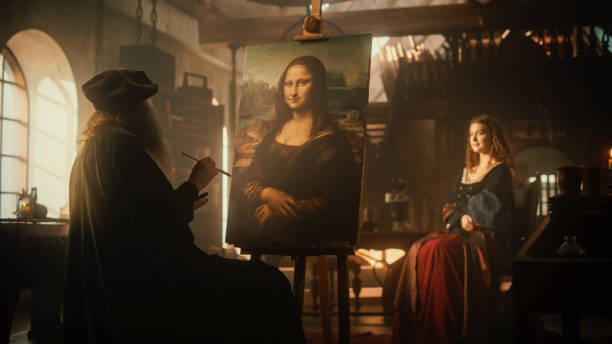
Around 1500, Da Vinci returned to Florence. He began working on what would become the world’s most famous painting, the Mona Lisa.
The painting, likely started around 1503, is celebrated for many reasons. Its subject, believed to be Lisa Gherardini, looks out from the canvas with a slight, mysterious smile. The background features a landscape that seems to shift as your viewing angle changes. Da Vinci used a technique called sfumato, which means blending tones and edges so they appear to fade into one another, like smoke. This technique gave the painting its soft, lifelike quality.
Psychologists and art historians have long studied the Mona Lisa. Some believe the painting captures micro-expressions, subtle emotional states that flicker briefly across a person’s face. Da Vinci was observing human psychology through his brush.
Additionally, modern imaging technology has revealed underpainting beneath the surface. This shows how many times Da Vinci adjusted and refined the work. He was never satisfied with anything too quickly.
The Science of Da Vinci’s Inventions
Many people know Da Vinci as a painter. Fewer people know just how far his scientific thinking reached. His notebooks contain thousands of drawings and notes on topics that feel completely modern.
He designed a flying machine based on the wings of a bat. He sketched a solar power concentrator. He drew an armored vehicle that looked like an early tank. He designed a bridge that needed no mortar. He even sketched what looks like a primitive robot, a mechanical knight that could reportedly move its arms and jaw.
None of these inventions were built in his lifetime. However, engineers in modern times have tested his designs. Many of them actually work. The parachute design, for example, was tested in 2000 by a skydiver using a replica made to Da Vinci’s exact specifications. It held.
So, Da Vinci was not just an artist who liked to doodle. He was thinking through problems with real physical understanding. His approach was scientific, systematic, and centuries ahead of his time.
Source: Wikipedia – Leonardo da Vinci
Da Vinci’s Final Years in France
After spending time in Rome from 1513 to 1516, Da Vinci received an invitation from King Francis I of France. The king admired him deeply. He offered Da Vinci a comfortable home at Clos Luce, near the royal court at Amboise.
In France, Da Vinci lived out his final years. He continued drawing and teaching. He refined several works, possibly including the Mona Lisa, which he had carried with him for years. He became a close companion to the king, who reportedly loved simply talking with him.
Da Vinci died on May 2, 1519, at the age of 67. According to legend, the king held his head as he passed away. Historians believe this story is likely romanticized, but it speaks to the deep admiration Francis held for the man.
What Modern Science Says About Da Vinci’s Brain
Interestingly, modern neuroscience has started looking at Da Vinci from a new angle. Researchers have analyzed his habits, his unfinished works, and descriptions from people who knew him personally.
Some scientists now believe Da Vinci may have had ADHD-like traits. His tendency to jump between projects, leave works unfinished, and hyperfocus on certain subjects fits a pattern familiar to researchers today. Additionally, some studies suggest he may have had dyslexia, based on the way he wrote backwards in his notebooks, from right to left in mirror script.
These traits, rather than holding him back, may have contributed to his genius. The ability to see connections across wildly different fields, from painting to engineering to biology, requires a mind that jumps around freely. Da Vinci’s brain may have been wired differently in ways that made him uniquely capable.
Source: Brain Journal via Oxford Academic
The Da Vinci DNA Project: Science Meets History
One of the most exciting developments in recent years is the Leonardo da Vinci DNA Project. This project brings together geneticists, genealogists, and anthropologists. Their goal is to trace Da Vinci’s genetic lineage and, eventually, reconstruct parts of his genome.
Researchers have traced his patrilineal family line across 21 generations, going all the way back to 1331. They identified matching Y-chromosome segments among living male descendants. Furthermore, they are analyzing remains from a family tomb in Vinci to confirm biological connections.
What makes this project particularly exciting is the possibility of recovering DNA from artworks linked to Da Vinci. A chalk drawing known as Holy Child may contain skin cells or other biological material left by him during creation. If this DNA can be recovered and matched, it could confirm whether the work is genuinely by Da Vinci.
Source: Science Daily – Da Vinci DNA Project 2025
Da Vinci’s Genome Could Answer Big Questions
If scientists can reconstruct parts of Da Vinci’s genome, the implications are enormous. Researchers could potentially identify genetic markers linked to visual acuity. This matters because Da Vinci’s ability to perceive fine detail and light was extraordinary.
They could also look for genes linked to creativity, memory, or left-handedness. Da Vinci was left-handed, a trait that appears in his paintings and notebooks. Genetic research might shed light on whether this contributed to his unique ways of seeing.
Beyond creativity, his genome could reveal health predispositions. What diseases might he have faced? What physical traits did he carry? In addition, the project could settle ongoing debates about disputed artworks. Authenticating a painting using DNA would be an entirely new way of confirming historical attribution.
The project could also clarify Da Vinci’s maternal origins, which remain historically murky. Combining genealogical records with genetic data could answer questions that centuries of historical research have not been able to resolve.
Da Vinci’s Legacy in Science and Art
Da Vinci was not the only genius of the Renaissance. However, he stands apart in one key way. He refused to choose between art and science. For him, both were paths to the same truth: understanding how the world actually works.
His anatomical studies influenced how doctors and artists understood the body. His engineering sketches foreshadowed inventions that would not arrive for centuries. His paintings changed how people thought about emotion, depth, and light. Moreover, his notebooks remain one of the most studied collections of ideas in human history.
Today, schools, museums, and research institutions around the world still draw from his work. His approach, observing carefully, questioning constantly, and drawing what you see, remains the foundation of both good science and good art.
Da Vinci Subheadings Reflect a Living Legacy
The reason Da Vinci continues to fascinate us is not just his talent. It is the totality of his curiosity. He did not decide what was worth knowing. Instead, he wanted to know everything.
He once wrote in his notebooks: “Learning never exhausts the mind.” This is perhaps the clearest summary of who he was. Even at the end of his life, surrounded by unfinished paintings and hundreds of sketches, he was still asking questions.
Modern science continues to find new layers in his life and work. Geological accuracy in his painted landscapes. New materials beneath the surface of his paintings. A DNA trail winding across 500 years. Each discovery adds something to our picture of the man.
Da Vinci was human, complicated, curious, imperfect, and brilliant. But more than anything, he reminds us that the greatest thing a person can do is pay attention to the world around them.
Sources and Further Reading
- Britannica: Leonardo da Vinci Biography
- Wikipedia: Leonardo da Vinci
- Museum of Science: Leonardo da Vinci
- Science Daily: Da Vinci DNA Project 2025
- Oxford Academic / Brain Journal: Neuroscience Analysis
- Smithsonian Magazine: Leonardo da Vinci features
- bioRxiv preprints and project updates (2025-2026)